Tuesday, June 14, 2016

EXTRA! EXTRA! TED Talk on Mental Illness

TED TALKS: TOWARD A NEW UNDERSTANDING OF MENTAL DISORDERS


It was especially interesting for me to watch the TED Talks "Toward New Understanding of Mental Disorders" because I have two close friends who suffer from mental illness (brain disorders), so this topic hits close to home for me. And I shouldn't say "suffer" so much as, they live with mental disorders that they have learned to effectively deal with to the point that I forget about their disorders most of the time- and I am around them ALOT. 

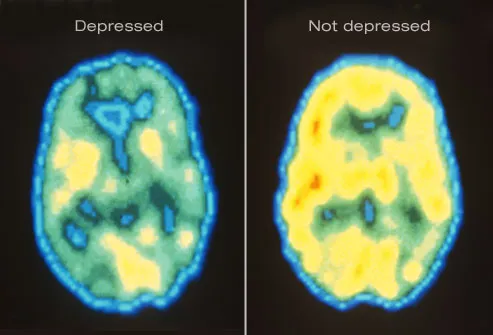
The brain is a fascinating yet overwhelmingly daunting thing that I feel we will never 100% understand. However, in this TED Talk, he examines the importance of understanding how we should be looking at mental disorders- that we need to be better educated and gain a more concrete understanding of how to help people with mental disorders. 

In the education world, students who have mental disorders are often misdiagnosed as having learning disorders or behavioral disorders. Furthermore, mental disabilities are shied away from, as people tend to be frightened by them rather than interested and willing to help. 

As teachers, it is important for us to realize the seriousness of mental disorders in children and young adults. When diagnosed and treated at an early age, people with mental illnesses learn effective coping skills that can help them through difficult times at school, especially in the adolescent years. Especially because suicide is the third most common cause of death for people between the ages of 15-25. That's SCARY but we also have the ability to help these people before it gets to that point. 

Mental illnesses SHOULD NEVER BE IGNORED. 


"What we need conceptually to make progress here is to rethink these disorders as brain disorders." 


Here is the link to the video: TED Talks: Toward a New Understanding of Mental Illness


Friday, June 10, 2016

Screen-cast-oh my goodness...

Alright so, for the first time ever, I used screencasting as a way to present my project. 
More on that later, but first. . .

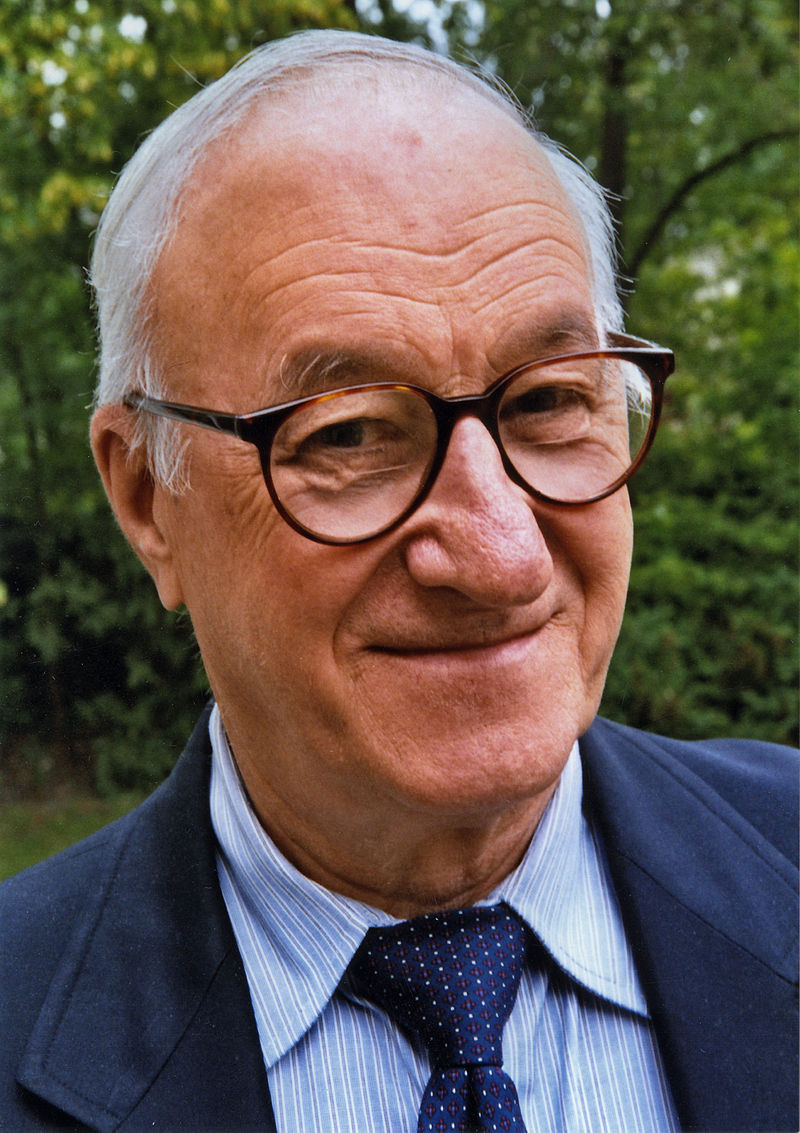
I researched psychologist Albert Bandura and his Social Learning/Social Cognitive theory (they are the same, the latter simply is more detailed as it was redeveloped and renamed). 
At the core, Bandura's theory focuses on learning through observation. He believes that people learn by watching others, and that children are influenced by "models"- adults, whose behavior they imitate.  

I found Bandura's theory to be very interesting, but it did disturb me. To me, the one thought I kept having while reading the research was this:  everything we do is based solely on the actions we have observed from other people. 
Scary. 

Bandura revised his Social Learning Theory and created the Social Cognitive Theory, which encompassed more than pure observation. The social cognitive theory suggested that there are other factors that influence our learning, such as the environment, social interactions, beliefs, and self-perception. 


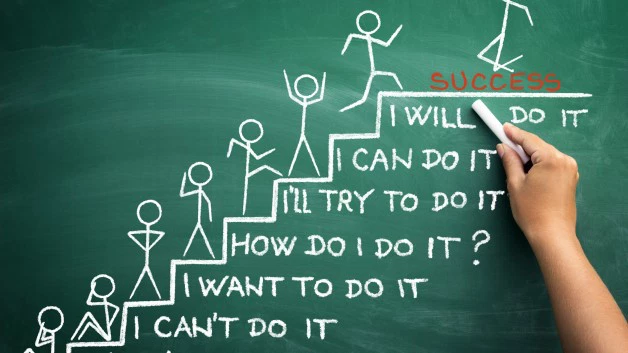
Bandura focused highly on self-efficacy: a person's belief in their own ability to succeed. I agree with the importance of self-efficacy. If we do not believe we will succeed, then we won't. It's as simple as that.   In the classroom, it is so important to encourage our students to try, and try their best. We must help our students build self-efficacy. 

For my presentation, I used screen-cast-omatic.  I was super nervous to do the screencasting, until I realized how simple it really is. 
I recorded my presentation twice. The first time, I sounded too nervous and then I went over the 15 minute limit. The second time was much smoother.  However, I still think it could have been better... but that's alright. 

Here is my presentation on Albert Bandura: 
Albert Bandura- Social Learning Theory

Music & Medicine

Ponder and reflect: Music and Medicine


To me, music is like magic. It has the power to say exactly what a person is thinking or feeling. Music can be used when someone fails to find the words to explain themselves. Music also gives people an outlet--whether they are listening to a song that describes their mood, or they are making music themselves, music is an escape, it is freedom, and it is incredible. 

Robert Gupta was a joy to watch, and his story is amazing. I am fascinated by the link between music and medicine, and always admired people who were going to school for music therapy.

Sunday, June 5, 2016

Characteristics of Intelligent People (fieldwork, task 2)


Here is the Prezi I created with the results of my interviewsIntelligence Is...

For task 2 of fieldwork, we were to interview 3-5 (or more) people, asking them to name three characteristics of intelligent people. I ended up really loving the conversations that this question started with people, and I went and asked 8 of my closest friends/family. I must say, the first thing I noticed (and was thrilled about) was that not one person used "smart" as a characteristic. 
I found that there were many similar answers, including "adaptability," "curiosity," and "open-mindedness." My favorite response was  "the ability to understand that they do not know everything." It is so important for people to realize that they do not know everything, that there is ALWAYS more to learn. That is how we grow as people. 
I very much enjoyed this fieldwork assignment. Intelligence, though defined in the dictionary, is not as black-and-white as a definition. An intelligent person has many character traits. All of the responses I received are correct, as there is no single type of intelligent person. 
This task reminded me that it is important for teachers to understand that there are many different types of intelligence, and that what makes one student intelligent may not be the same in another student. 

Thursday, June 2, 2016

Create, Evaluate, Reflect: C.E.R. 1, 2, & 3

CREATE, EVALUATE, REFLECT
C.E.R. 1


CREATE:
CER 1
Create:
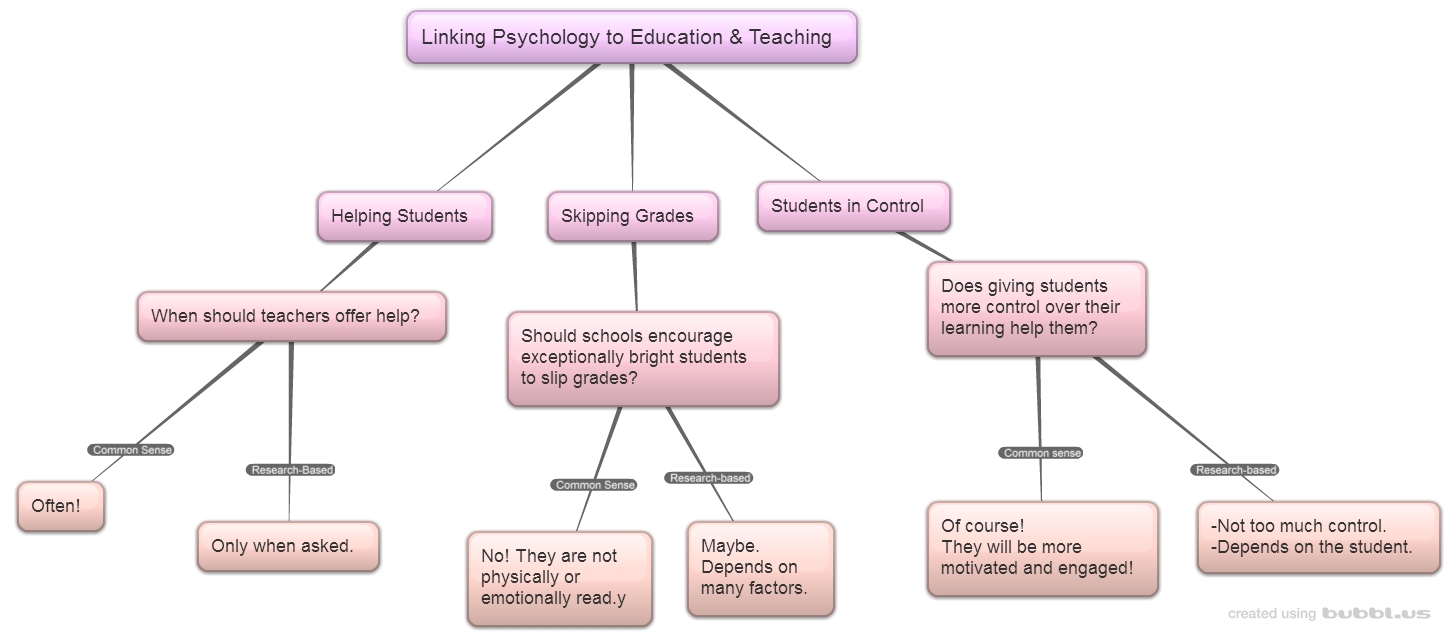
New-Mind-Map_5d08qias.jpg

I used https://bubbl.us/mindmap to create this concept map. I found the website to be fun, and pretty simple. Plus, it’s free!! :)


EVALUATE:


Conduct a web inquiry and compile a useful list of websites that contain examples of the following:


  1. Irrelevant advice: http://www.great-ideas.org/


  1. Lessons- things to watch out for/mistakes to avoid: http://www.teachhub.com/10-classroom-management-mistakes-avoid


RELATE:


Based on this article: Teacher Research Informing Policy: An Analysis of Research on Highly Qualified Teaching and NCLB, Audrey Amrein-Beardsley, Arizona State University


  1. What does it mean to be a qualified teacher?
According to NCLB, a qualified teacher is a teacher who has a bachelor’s degree or higher, has the content knowledge required to teach core subjects, and (usually) holds a state teaching license (Amrein-Beardsley, 1). With NCLB, “now more than ever, high quality teachers are vital only to the extent that they improve student academic achievement” (Amrein-Beardsley, 1). The criteria for a “qualified” teacher is heavily linked to student academic achievement. What this means to me is that, to be a highly qualified teacher, your students must score high on state exams, and must have higher than average grades. I do not believe that this is how teachers should be determined to be “qualified.” To me, a qualified teacher is someone who teaches with their heart, not with the end-goal being superb test scores. Highly qualified teachers know their students on a personal, individual level. They understand that students do not all learn in the same way, or at the same rate, and can adjust their instruction accordingly. Highly qualified teachers use many methods and activities to get their students to not only memorize but understand and relate to the content they are learning. A highly qualified teacher can relate lessons to students’ lives, giving their students motivation to learn. Highly qualified teachers care about their students, not just the test scores.


  1. How do you assess qualifications?


Sure, certification can be considered when assessing qualifications of a teacher. But that is, by far, NOT the only thing to be assessed. Qualifications should be assessed by observing student-teacher relationships, classroom management, and overall passion and dedication to the job. A teacher can have three Master’s degrees and a PhD, but if they are not personable and cannot relate to their students then, to me, they do not have all of the proper qualifications.


  1. What is good teaching, and how is it measured?


Good teaching utilizes many different types of instruction in the classroom. Good teaching is when a teacher can create engaging activities for their students, and when they know how to tailor their lesson plans to meet the needs of the students in their class. Good teaching is when a teacher uses more than just written exams to assess their students, and instead uses hands-on, minds-on activities, cooperative learning, technological projects, and by allowing as much student-centered learning as possible.


  1. How do qualifications make a difference? What knowledge or skills would a qualified teacher possess that an unqualified teacher does not?


Qualified teachers possess an understanding that students are people, not just another number. They see the needs of each of each of their students individually, whereas unqualified teachers view their class as a single student, so to speak, and believe that one teaching method will work for every child.


  1. How do school systems that may have a paucity (scarcity) of “qualified teachers” (such as rural and urban schools) work to meet the requirements of No Child Left Behind?


No Child Left Behind unfortunately punishes teachers and schools with low performance scores on state assessments. When scores are low enough, teachers fear being fired and schools fear that they could be closed. Of course increasing teacher salary would “ensure every classroom is lead by a highly qualified teacher” however, there is not a budget for that. I think that what needs to be done, is NCLB needs to be looked over again. Perhaps it is not the teachers or the students, but the area in which the school is located?

Wednesday, June 1, 2016

the power of STEAM and Effective Teaching (Fieldwork, Task 1)

For my first fieldwork task, I had the pleasure of interviewing a 3rd-5th grade STEAM (science, technology, engineering, arts, mathematics) teacher. She has been teaching in her district for over 20 years, but this is her first year as a STEAM teacher. She was hired as the first ever teacher of this kind in the district, and was thrilled to accept the position. Her previous classrooms include Pre-K, Kindergarten, & First Grade. When speaking with Mrs. C, she was nothing but passionate and enthusiastic about her new position! She spoke about the effectiveness and the importance of a teacher truly knowing their students, so that their learning needs can be met, i.e: the way in which a student learns. Mrs. C forms connections with her students beginning on the first day of school. This has been her routine since she first began her teaching career. She builds strong bonds with her students, which motivates and encourages them to try their best, every day.  
  • What effective teaching principles do you follow to reach every child in your classroom?

*I look to see which learning modality the child learns best through, Kinetic, auditory, visual or a combination and then differentiate the lesson to their meet their needs.
*I create lessons that try to meet a combination of learning styles.
*Work in small groups to pre teach or review lessons given to the whole class or work with small groups based on ability to teach specific lessons.
* I ask many open ended, higher level questions and keep an open environment that there are no bad answers, a wrong response or mistake only helps to lead to a better answer. Brainstorming leads to stronger and more interesting answers. The first answers are not always the best.

  • What latest research are you referring to in your teaching design.
*As a STEAM teacher, my lessons are project based, using the Engineering design process. We are also fostering an atmosphere of perseverance and not giving up when the design as planned doesn’t work. That learning comes from failure (FAIL-first attempt in learning) and learning growth from not giving up on finding a solutions. This year I am also researching many different robotics programs that allow for creative discovery such as LittleBits, Code.org, BeeBots (https://www.bee-bot.us/), Lego robotics, Dash and Dot, and Spero.


  • In what ways does the research on effective teaching empowers teachers' continued learning process?


*My role as a STEAM teacher requires me to create or research activities which bind together experiences with Science, math, engineering technology and the arts. The lessons not only look at the STEAM activity but includes writing, research and creative problem solving.

Sunday, May 29, 2016

The Importance of Teachers

Anita Woolfolk pretty much hits the nail on the head in her podcast about the the importance of teachers. Anita discusses that teachers are so much more than instructors. They are lifelines.

Anita explains how important it is for teachers to truly care about their students, stating “people need to belong and feel safe before they can focus on learning and knowledge." That is my favorite line from the podcast.

There are so many teachers who spend their whole time teaching to the state tests, and do not take the time to form relationships with their students. However, this has shown to hurt, rather than help, student performance. Students who believe that their teachers care about them are higher achievers and are more resilient. 
I LOVE that students were asked what makes a great teacher. Because at the end of the day, students are the ones in the classroom. Here is what they said:
Teachers show they care by:

  • Trying to make class interesting
  • making sure everyone understands the material
  • asking “what's wrong?" 
  • being fair & respectful
  • offering choices
  • showing interest in their students
  • trusting & respecting their students
  • caring about them as learners and as people

Here is a link to the podcast: The Importance of Teachers